
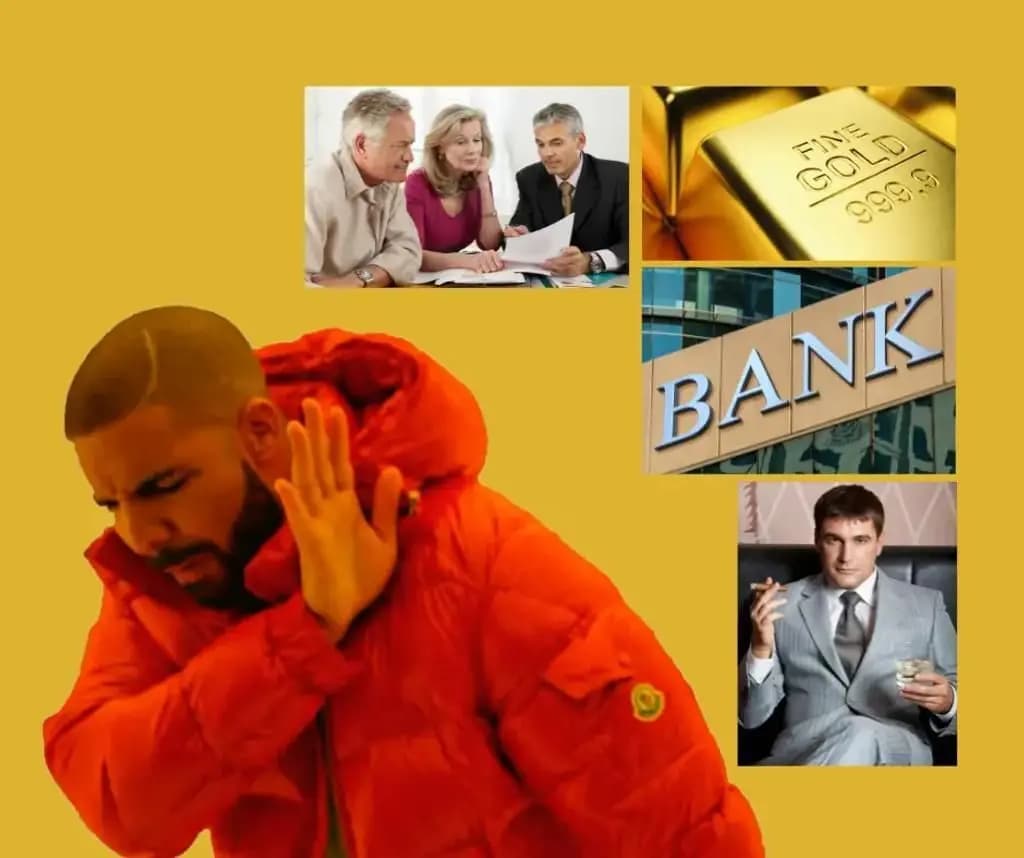
Ulaganje i štednja - 4 savjeta gdje se NE informirati
 Hrvoje Vargić6 min čitanja
Razmišljaš o budućnosti i shvaćaš da ti je za ostvarenje životnih ciljeva potreban novac koji (trenutno) nemaš? Kupnja stana, školovanje ili pokretanje vlastitog posla – za sve to su ti potrebni štednja i ulaganje.
Pitanja je stotinu: što učiniti s novcem, gdje uložiti, kako dobiti najbolju kamatnu stopu itd. No, gdje se informirati u tom trenutku? Koga pitati za savjet?
Za početak, evo nekoliko savjeta gdje se NE informirati:
1. Kod službenika u banci
Velik broj ljudi će se oko štednje i ulaganja prvo obratiti službeniku u banci. Naravno, zaposlenici banke jedva čekaju da im se obratiš kako bi ti ponudili neki od proizvoda banke.
No, štednje koje banke trenutno nude su dosta loše. Na štednju u banci (oročenu, stambenu, dječju - svejedno) ćeš dobiti kamatu od mizernih 0,1% do 0,2%. S inflacijom od 2% godišnje, realna vrijednost 1000 kn koje staviš na štednju bi nakon 20 godina iznosila 697,48 kn. Ne isplati se baš.
U banci će ti možda ponuditi i ulaganje u investicijske fondove. Ti fondovi u pravilu naplaćuju visoke ulazne i izlazne te naknade za upravljanje. One se često penju i do 3-4% godišnje. To ti se možda neće učiniti puno ako ti u banci pokažu kako je neki fond u zadnjih 5 godina ostvario prosječni prinos od preko 11% godišnje.
No, prošli prinosi nisu garancija budućih. Statistike pokazuju da većina fondova koji su najuspješniji u jednom petogodišnjem razdoblju u sljedećem razdoblju to više nisu. Uspješna strategija koja pobjeđuje ostale rijetko kada ostaje uspješna na dugi rok. U razdoblju od 20 godina čak 95,61% aktivno upravljanih fondova zaostaje za tržištem.
Postoje puno bolje opcije od onih koje će ti ponuditi banka. Ipak, zaposlenik banke ti ne može to reći jer mu je u interesu prodati njihov proizvod. To je sasvim normalno. Ali se ti onda trebaš informirati na drugom mjestu.
2. Kod „financijskih savjetnika“
Slična je stvar i s financijskim savjetnicima. (Radio sam taj posao pa znam.) Oni će te najčešće nazvati i reći da te preporučio neki prijatelj ili poznanik. Ako je prijatelj dobro odradio svoj dio posla, prije toga ti se javio i rekao da će te nazvati financijski savjetnik.
Financijski savjetnici su najčešće zaposlenici osiguravajućih kuća. Postoje i oni koji surađuju s različitim osiguravateljima i bankama. Financijsko savjetovanje će zapravo biti uvertira u prodaju nekog od proizvoda kuće.
No, prvo će ti objasniti piramidu financijskih potreba, pitati te koje su tvoji financijski ciljevi i sl. Tek na drugom sastanku će ti pokušati prodati proizvode – (najčešće životno) osiguranje i štednju.
Savjetnik će ti životno osiguranje predstaviti kao način štednje i ulaganja. Vjerojatno će ti pokazati neki graf na kojem su tržišta rasla 10-12%, a on će pak skromno uzeti nešto konzervativniji izračun sa 6-8% te pokazati kako ćeš s tim prinosima na duži rok moći npr. kupiti stan.
U tih 6-8% neće uračunati sve naknade koje ćeš plaćati i u izračun često neće biti uračunata tzv. „osigurana svota“. Kod životnog osiguranja većina tvojih uplata u prve 3 godine koristiti se za pokriće „osiguranog slučaja“ (tj. smrti). Tek nakon toga se novac ulaže. Financijski savjetnik će ti to reći, ali se najčešće neće vidjeti u izračunu.
Kod životnog osiguranja ćeš tek nakon 10 godina uplata biti na nuli, a moguće i kasnije. Životno osiguranje samo po sebi nije loš proizvod (i sam ga imam). Ali nije primarno štedni ili ulagački proizvod kakvim ga savjetnici prikazuju. To je osiguranje, ne ulaganje. Ako želiš uložiti novac i dobiti najbolje prinose, ne kupuj životno osiguranje.Naravno, financijski savjetnici ti neće to reći jer im je u interesu prodati vlastiti proizvod. To je sasvim normalno. Ali ti se onda trebaš informirati na drugom mjestu.
3. Kod prodavatelja investicijskog zlata
Kao i prvim dvjema skupinama, prodavateljima investicijskog zlata u cilju je prodati vlastiti proizvod. Takvo ulaganje nužno biti najbolje za tebe.
Prodavatelji zlata prikazat će ti jedan od sljedećih grafova:
- Kretanje cijene od kraja 2015. gdje je cijena zlata rasla preko 8% godišnje
- Kretanje cijene u razdoblju od 2000.-2020. gdje je zlato raslo preko 9% posto godišnje (u usporedbi s npr. mirovinskim fondovima koji su imali prinose oko 5%)
- Kretanje cijene od početka 1970-ih od kada je cijena zlata narasla preko 40 puta
Ovi podaci su točni, ali postoji problem. Sva vremenska razdoblja su uzeta po kriteriju da je u početnoj godini cijena zlata bila na jako niskim razinama. Na grafu ispod vidi se da je cijena zlata 1971., 2000. i 2015. dotakla dno. Kad se uzmu te godine kao početne, rast se čini ogromnim.

S druge strane, u razdoblju od 1980. do 2000. cijena zlata je konstantno padala. Kad se pogleda kretanje cijene zlata u posljednjih 100 godina, vidi se da je nemoguće očekivati stalni rast cijene od 8-9% godišnje.
Često prodavatelji investicijskog zlata ističu kako je zlato dobra štednja za mirovinu i sigurna luka u krizi. Nijedno nije sasvim točno. Zlato ne isplaćuje dividende i jedini način zarade je na rastu cijene. To baš i nije najbolji način za isplaćivati si mirovinu.
Ujedno, korelacija zlata i dionica je 0. To znači da kad dođe kriza i cijene dionica padnu, sa zlatom ne znamo što će se dogoditi. Možda će biti otporno na krizu, možda neće.
Ipak, zlato je još jedno legitimno ulaganje. Može biti dobra zaštita od inflacije, ima stvarnu vrijednost u podlozi (koristi se u industriji) i vrlo je likvidno (može se brzo i lako prodati). Pogodno je za određeni (u pravilu manji) dio portfelja. Problem je što ga prodavatelji krivo predstavljaju. Stoga se ni kod njih ne trebaš informirati o ulaganju jer nećeš dobiti najbolju informaciju za sebe.
4. Kod financijskih gurua
Sigurno si se bar jednom našao u sljedećoj situaciji. „Skrolaš“ po društvenim mrežama kad te odjednom zatekne sponzorirana objava. Muškarac u skupom odijelu, sa skupim satom i savršenim osmijehom ti se obraća sa slike ili videa uživo. Upravo se nalazi u skupom hotelu na nekom seminaru i želi da i ti dobiješ dio doživljaja.
Najavljuje nevjerojatnu ponudu. Samo moraš pročitati/ poslušati do kraja i reći ti sve o njoj.
On je višestruko nagrađivani autor, influencer i biznismen. U svojim biznisima do sada je zaradio milijune (ne spominje koji su to). Preporučuje ga tisuće klijenata koje je do sada savjetovao.
Sada može pomoći i tebi. Naravno, ako si spreman.
Jesi li spreman za potpunu financijsku preobrazbu i zagarantiran financijski uspjeh?
Ako jesi, predbilježi se i ostvari nevjerojatan popust od 90% SAMO DANAS (iako ti se oglas vrti po zidu već mjesec dana).
Za tu super-prikladnu cijenu možeš dobiti e-knjigu, webinar, seminar, coaching ili nešto slično.
U većini slučajeva proizvod je sadržajno prazan, a prepun marketinških fraza. Nažalost, danas su mnogi usvojili tehnike uvjeravanja i koriste ih kako bi ti prodali – maglu.
Kad vidiš objavu sličnog tipa, zaobiđi ju u širokom luku. Ne kažem da u jednom od 10 slučajeva proizvod neće biti dobar, ali ne isplati se riskirati.
Gdje god je marketing toliko naglašen, vjerojatnije je da to nije mjesto gdje ćeš naučiti nešto o financijama. Postoje puno bolji izvori za to.
O nekim od tih izvora planiram pisati u sljedećim člancima.
________________________
Još s bloga
Sve objave
Čitanje u svakoj dobi: kako ponovno pronaći vrijeme za knjigu?
Koliko si puta rekao da nemaš vremena za čitanje? Knjiga čeka na polici, ti pogledaš naslovnicu i pomisliš: „Pročitat ću je kad uhvatim malo vremena.
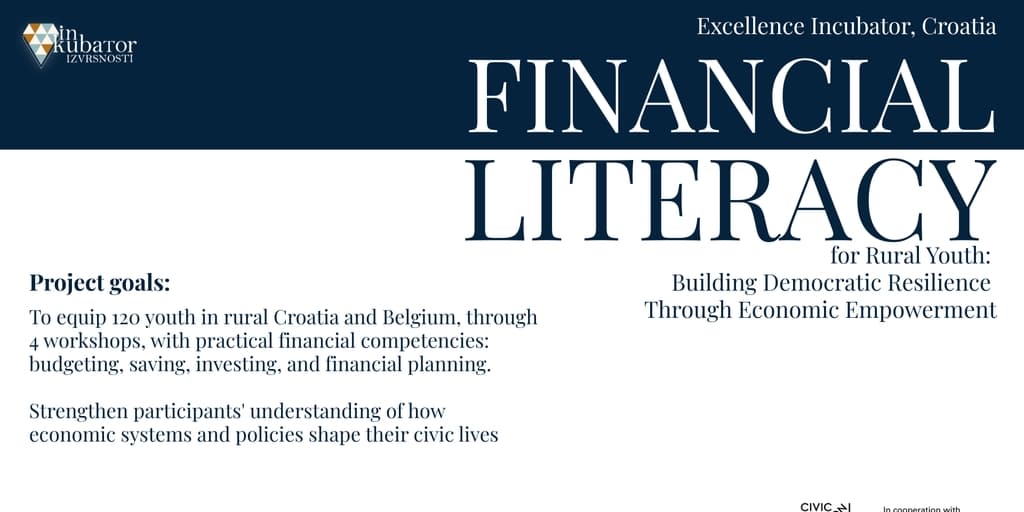
More Than Money: Why Financial Literacy Is a Democratic Competence
Reflections from the Financial and Economic Literacy NECE Lab, Vienna, 27–28 April 2026 When we talk about financial literacy, most people picture budgeting apps, savings accounts, and the fine print on a loan agreement. Useful things, but a narrow picture. Increasingly, educators, researchers, and policymakers across Europe are making a bigger claim: understanding money is not only a personal survival skill. It is a foundation of active citizenship and democratic resilience. That claim was the beating heart of the Financial and Economic Literacy NECE Lab in Vienna, a two-day gathering hosted by THE CIVICS Innovation Hub together with Znanje na djelu and the Erste Financial Life Park (FLiP), with the support of ERSTE Foundation. We were proud to be part of it, having Magdalena Basić Alando actively participate and present our own project, Financial Literacy for Rural Youth, and learning alongside practitioners from across the continent. This post pulls together what the research actually says, and what we saw play out in the room. The problem: too many young people can't apply what they know Start with the evidence. In the OECD's most recent international assessment of 15-year-olds, released in 2024, the picture is sobering: across the 14 OECD countries assessed, 18% of students on average do not have basic proficiency in financial literacy, meaning they cannot apply their knowledge to real-life situations involving financial decisions. The gap is not evenly distributed. Socio-economically disadvantaged students are over-represented among low performers, which risks entrenching inequality as those students become adults. In other words, the young people who most need economic confidence are the ones least likely to be given it — a pattern that maps neatly onto who feels shut out of public life more broadly. There is a hopeful flip side. Financial literacy and positive financial behaviour are linked: students with stronger skills behave more responsibly with money and are more forward-looking, with high performers markedly more likely than low performers to save. Skills, attitudes, and behaviour move together — which is exactly why how we teach matters as much as what we teach. The bigger claim: financial literacy feeds democratic participation Here is where the Vienna conversation went beyond personal finance. One of the Lab's expert speakers was Anna Lo Prete of the University of Turin, whose research sits right at this intersection — and whose work is among the clearest evidence we have on the question. Lo Prete's cross-country analysis documents a positive association between political participation — measured by the number of citizens voting in national elections — and the awareness of the trade-offs behind private and public decisions that basic financial education captures. Crucially, this is not just correlation dressed up: empirical models that control for a large set of other determinants of voter turnout indicate that financial literacy continues to have a positive and causal impact on electoral participation. Why would that be? The logic is intuitive once you see it. Understanding some economics and finance helps citizens grasp the reasons behind public intervention and weigh the pros and cons of policy proposals and agendas. A voter who understands taxation, public budgets, inflation, and debt is simply better equipped to evaluate the promises on a ballot — and harder to mislead. The catch: financial literacy alone isn't enough It would be too easy to conclude "teach kids about compound interest and democracy takes care of itself." The research is more demanding than that — and this nuance came up repeatedly in Vienna's group work. A recurring critique in the academic literature is that much mainstream financial education quietly frames citizens as consumers rather than participants. One influential analysis argues that dominant financial literacy programmes can end up promoting a limited, consumerist form of civic engagement, and that what is really needed is a critical, emancipatory civic financial literacy for an engaged citizenry able to extend and protect more robust conceptions of freedom and democracy. Scholars working on integrative economic education put the point sharply: financial literacy without civic competence remains a merely reactive skill rather than a source of genuine political agency, which is why financial literacy and civic competences should be understood as parts of a single integrative concept of economic education. The two only reach their full value when taught together — money knowledge that can read the system, not just cope with it. Europe is building the scaffolding None of this is happening in a vacuum. The policy architecture is catching up with the research. In 2023 the European Commission and the OECD jointly published a Financial Competence Framework for Children and Youth in the European Union. It is not only about interest rates and risk: alongside the four core content areas — money and transactions, planning and managing finances, risk and reward, and the financial landscape — the framework deliberately integrates cross-cutting dimensions including digital finance, sustainable finance, entrepreneurship, and citizenship. Citizenship is written into the framework by design. On the civic side, the Council of Europe's Reference Framework of Competences for Democratic Culture exists precisely to equip young people with the competences needed to defend and promote human rights, democracy and the rule of law, to act as active citizens, and to live peacefully together with others. Read the two frameworks side by side and the overlap is obvious: critical thinking, informed decision-making, and the confidence to participate. What this looks like in practice: rural youth and economic autonomy This is the gap our own project set out to close, and the reason we were presenting it in Vienna. Financial Literacy for Rural Youth: Building Democratic Resilience Through Economic Empowerment merges financial and civic education for an audience usually left out of both: young people in rural areas, who are systematically underrepresented in programmes that tend to be urban-centred. Working with our partners, the project equips rural GenZ participants in Croatia and Belgium with practical competences: budgeting, saving, investing, planning; through gamified, peer-to-peer, blended learning adapted to rural digital realities. But the design goes a step past personal finance, exactly along the lines the research recommends. Participants learn to analyse economic policies, financial products, and media narratives about money, so they can resist manipulation and make informed civic choices. The premise is that economic dependency and exclusion are themselves barriers to democratic participation, and that when young people understand how taxation, public budgets, and economic policy shape their own lives, they engage more meaningfully in democratic processes. A transnational peer exchange between Croatian and Belgian participants adds a cross-cultural, shared-European dimension, a small counterweight to the polarisation that tends to follow economic marginalisation. The pilot trainings in Croatia are already complete, with workshops in Belgium still ahead. And the methodology is being built to outlast the project and be shared amongst all stakeholders. Where the formal and non-formal worlds meet If there was one moment in Vienna that made the abstract concrete, it was the guided tour of the Erste Financial Life Park (FLiP), FLiP turns financial education into something you can walk through and touch: interactive stations where visitors make real-feeling budgeting decisions and immediately see the consequences. It is a vivid rebuttal to the idea that money education has to be dry. A theme the NECE Lab kept returning to, and one the research underlines, is the relationship between formal schooling and non-formal education. Classrooms provide reach and legitimacy; non-formal initiatives like ours provide the agility to reach underserved groups, experiment with gamified and peer-led methods, and adapt fast. The most promising path forward is not one or the other, but connective tissue between them: school systems that borrow the energy of non-formal approaches, and civic organisations whose toolkits can be picked up and used inside classrooms. The takeaway The case made in Vienna, and backed by the evidence, is straightforward but consequential. Financial literacy is not merely about helping individuals stay solvent. Done well, paired with civic competence rather than reduced to consumer advice, it strengthens people's capacity to understand the systems they live in, to resist manipulation, and to participate in the democratic decisions that shape their economic lives. In an era of rising costs, growing inequality, and declining trust in institutions, that capacity is not a luxury. It is infrastructure for democracy. We left Vienna grateful to all speakers for the intellectual grounding; to our fellow educators for the knowledge exchange and the good company; to the organisers: THE CIVICS Innovation Hub, Znanje na djelu, Erste Financial Life Park, and ERSTE Foundation, FLiP centre. The next chapter is being written in rural classrooms and community halls across Europe. We're glad to be part of it. Sources OECD (2024), PISA 2022 Results (Volume IV): How Financially Smart Are Students?, OECD Publishing. Lo Prete, A. (2024), Political participation and financial education: Understanding personal and collective trade-offs for a better citizenship, Economics Letters / ScienceDirect. Lo Prete, A., Financial education: From better personal finance to improved citizenship, Journal of Financial Literacy and Wellbeing, Cambridge Core. Arthur, C. (2012), Financial Literacy Education for Citizens: What Kind of Responsibility, Equality and Engagement?, Citizenship, Social and Economics Education (SAGE). Integrative Economic Education to Combine Citizenship Education and Financial Literacy (ResearchGate). European Union / OECD (2023), Financial Competence Framework for Children and Youth in the European Union, OECD Publishing. Council of Europe, Reference Framework of Competences for Democratic Culture (RFCDC).

Životni skript: zašto ponavljaš iste obrasce i kako ih promijeniti?
Jesi li ikad primijetio/la da u različitim vezama završavaš s istim tipom problema? Ili da na poslu uvijek ulazi u istu vrstu sukoba --- bez obzira...
