

7+1 najvažnijih stvari kod potpora za samozapošljavanje (2. dio)
Državne mjere samozapošljavanja glavni su izvor državne financijske potpore za nezaposlene osobe koje žele pokrenuti vlastiti posao u nekoj od mjerama predviđenih djelatnosti. U prvom dijelu započeli smo niz najvažnijih stvari koje trebaš znati o poticajima za samozapošljavanje, a ovdje ti donosimo nastavak.
5. Koji su troškovi prihvatljivi?
Podsjećamo kako se od ove godine potpora za samozapošljavanje sastoji od 2 dijela: fiksnog i varijabilnog. Fiksni se dio dodjeljuje de facto nenamjenski i za njega ne postoje posebne odredbe glede prihvatljivih troškova. S druge strane, prihvatljivi troškovi unutar varijabilnog iznosa razvrstani su u 8 kategorija:
- kupnja strojeva, tehnike, alata
- kupnja informatičke opreme
- kupnja IT programa
- edukacije vezane uz djelatnost – do 30% iznosa potpore
- kupnja novih prijevoznih sredstava (osim teretnih motornih vozila)
- kupnja sirovine i potrošnog materijala (samo prerađivačka industrija) – do 20% iznosa potpore
- kupnja franšiza
- usluge neophodne za korištenje kupljene opreme
- PDV iskazan na računima, koji nije povratim prema propisima o PDV-u.
Osim toga, novčanu potporu varijabilnog iznosa možeš ostvariti isključivo na osnovu primarne djelatnosti poslovnog subjekta prijavitelja. To znači da bez obzira na broj ili srodnost djelatnosti s kojima se novi poslovni subjekt prijavljuje, Troškovnik treba sadržavati stavke koje se odnose na pokretanja i obavljanje djelatnosti koja je navedena kao primarna. Zato unaprijed trebaš voditi računa o planiranju poslovanja prema djelatnostima i odabrati onu primarnu djelatnost koja najviše odgovara tvom Poslovnom planu i Troškovniku, odnosno kategoriji potpore koju želiš dobiti.
6. Kako se prijave boduju?
Dva glavna kriterija za vrednovanje prijave jesu:
1) potpunost tražene dokumentacije
2) valjanost troškovnika.
Maksimalan je broj bodova 100, a donji prag za pozitivnu ocjenu iznosi 65 bodova. Ovo su elementi bodovanja:
- radno iskustvo u djelatnosti za koju se prijavljuje: 15
- Poslovni plan i Troškovnik: 15
- procjena prihoda i troškova: 15
- obrazovanje ili dodatne edukacije u djelatnosti: 10
- pripremne radionice/savjetovanja Hrvatskog zavoda za zapošljavanje: 10
- indeks razvijenosti jedinice lokalne samouprave: 10
- održivost i konkurentnost poslovnog plana: 10
- prvo poduzetničko iskustvo: 5
- inovativnost projekta: 5
- ulaganje u nedostajuće djelatnosti: 5
Primjer: Recimo da živiš u Babinoj Gredi i prijavljuješ se na potporu za samozapošljavanje jer želiš pokrenuti obrt s primarnom djelatnosti fasadnih i štukaturskih radova. U toj djelatnosti imaš srednju stručnu spremu koja ti je potrebna za obavljanje te vezane djelatnosti i na temelju toga ostvaruješ 10 bodova. Za dobro popunjen poslovni plan, troškovnik i priložene predračune dobivaš 15 bodova, a toliko dobivaš i na osnovi procjene tvojih prihoda i troškova. Temeljem indeksa razvijenosti za Babinu Gredu dobit ćeš 10 bodova, a kako je riječ o deficitarnoj djelatnosti, za tu stavku dobivaš dodatnih 5 bodova. To je ukupno 55 bodova. S druge strane, ovo ti nije prvo poduzetničko iskustvo, ali nemaš radnog iskustva u djelatnosti s kojom se prijavljuješ. A iako imaš dobar poslovni plan za početno razdoblje od dvije godine, on ipak nije dovoljno inovativan, održiv i konkurentan, zato ostaješ bez bodova za te stavke. Srećom, prije predaje zahtjeva pohađaš radionicu HZZ-a o mjerama samozapošljavanja i zahvaljujući tome dobivaš dodatnih 10 bodova. Tako dolaziš do ukupnih 65 bodova koji su ti dovoljni da ostvariš pravo na potporu.

Prema tome, važno je da koristiš sve pogodnosti koje ti se pružaju, kao što je u ovom primjeru besplatna radionica HZZ-a, koja ti može donijeti odlučujućih 10 bodova u prijavi.
7. Obveze i važni uvjeti
Potpora za samozapošljavanje traje 24 mjeseca. Prijavitelji koji ostvare pravo i dobiju potporu dužni su pridržavati se niza obveza propisanih Uvjetima i načinima korištenja sredstava za provođenje mjera u 2021. godini. Između ostaloga, korisnik potpore dužan je:
- 24 mjeseca održati poslovanje i zaposlenost u poslovnom subjektu kojem je dodijeljena potpora
- namjenski utrošiti varijabilni iznos potpore tijekom prvog 12-mjesečnog ugovornog razdoblja sukladno odobrenom troškovniku
- na vrijeme dostaviti potvrde Porezne uprave o stanju nepodmirenih obveza
- ostvariti ukupni promet od obavljanja djelatnosti u razdoblju od 24 mjeseca od prijave u HZMO u iznosu od najmanje 50% dodijeljenog iznosa potpore.
U slučaju zatvaranja poslovnog subjekta i odjave iz radnog odnosa prije isteka 24-mjesečnog razdoblja ili prijave na nepuno radno vrijeme, korisnik vraća isplaćena sredstva uvećana za zakonsku zateznu kamatu, i to na sljedeći način:
1. ako je kršenje navedenih obveza nastalo u prvom 12-mjesečnom razdoblju, vraća ukupno isplaćeni iznos potpore
2. ako je kršenje navedenih obveza nastalo u drugom 12-mjesečnom razdoblju, vraća ukupni iznos varijabilnog dijela potpore i 50% fiksnog iznosa isplaćene potpore.
+ 1 važna napomena…
Kao podnositelj zahtjeva moraš biti evidentiran u evidenciju nezaposlenih osoba Hrvatskog zavoda za zapošljavanje. Važno da u evidenciji Zavoda budeš sve do trenutka pokretanja poslovnog subjekta i dobivanja rješenja zahtjeva za dodjelu potpore. O tome je važno voditi računa zato što možeš izgubiti status nezaposlene osobe i bez stupanja u radni odnos. Prema Zakonu o tržištu rada, u evidenciji nezaposlenih osoba prestaješ se voditi ako ostvariš primitak od pružanja nekih usluga veći od iznosa prosječne novčane naknade u prethodnoj kalendarskoj godini, a to je 2433.45 kn. Ako si u nedavnoj prošlosti obavljao/la neke usluge temeljem ugovora o djelu za koje te još nisu platili, a trenutno si nezaposlen/a i planiraš se prijaviti na mjere za samozapošljavanje, vodi računa o tome da ti uplata ne stigne u krivom trenutku.
Planiranje, planiranje, planiranje…
Kao što vidiš, planiranja nikad dovoljno. Mnogo je stvari koje trebaš znati ako razmišljaš o samozapošljavanju uz pomoć državnih poticaja. Ovdje smo izdvojili 7 + 1 najvažniju stvar bez kojih ne možeš. To ti može poslužiti kao početna orijentacija u planiranju – s kojim trebaš početi što prije ako želiš iskoristiti sve što ti se nudi.
________________
Hvala ti na čitanju i hvala što nas pratiš. Na naše edukacije možeš se pretplatiti ovdje.
Još s bloga
Sve objave
Čitanje u svakoj dobi: kako ponovno pronaći vrijeme za knjigu?
Koliko si puta rekao da nemaš vremena za čitanje? Knjiga čeka na polici, ti pogledaš naslovnicu i pomisliš: „Pročitat ću je kad uhvatim malo vremena.
More Than Money: Why Financial Literacy Is a Democratic Competence
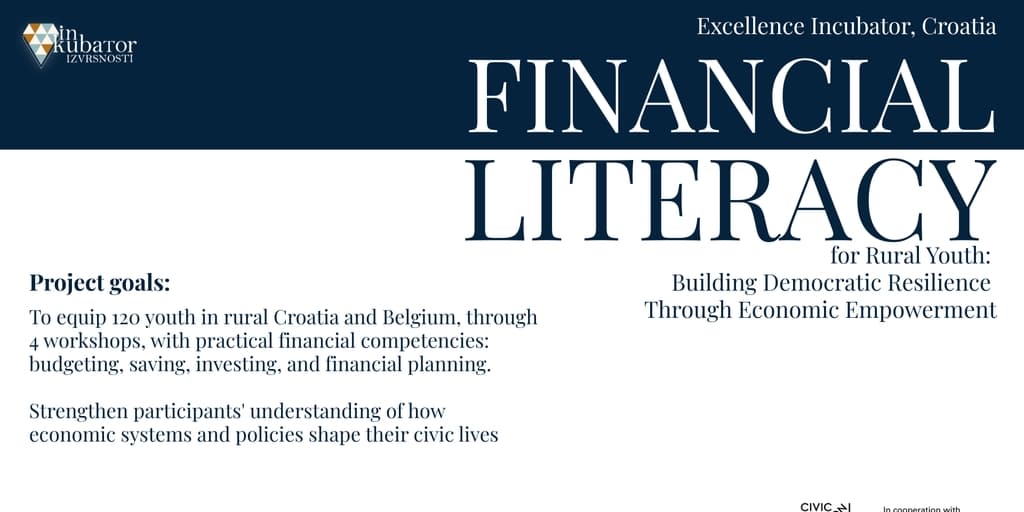
Reflections from the Financial and Economic Literacy NECE Lab, Vienna, 27–28 April 2026 When we talk about financial literacy, most people picture budgeting apps, savings accounts, and the fine print on a loan agreement. Useful things, but a narrow picture. Increasingly, educators, researchers, and policymakers across Europe are making a bigger claim: understanding money is not only a personal survival skill. It is a foundation of active citizenship and democratic resilience. That claim was the beating heart of the Financial and Economic Literacy NECE Lab in Vienna, a two-day gathering hosted by THE CIVICS Innovation Hub together with Znanje na djelu and the Erste Financial Life Park (FLiP), with the support of ERSTE Foundation. We were proud to be part of it, having Magdalena Basić Alando actively participate and present our own project, Financial Literacy for Rural Youth, and learning alongside practitioners from across the continent. This post pulls together what the research actually says, and what we saw play out in the room. The problem: too many young people can't apply what they know Start with the evidence. In the OECD's most recent international assessment of 15-year-olds, released in 2024, the picture is sobering: across the 14 OECD countries assessed, 18% of students on average do not have basic proficiency in financial literacy, meaning they cannot apply their knowledge to real-life situations involving financial decisions. The gap is not evenly distributed. Socio-economically disadvantaged students are over-represented among low performers, which risks entrenching inequality as those students become adults. In other words, the young people who most need economic confidence are the ones least likely to be given it — a pattern that maps neatly onto who feels shut out of public life more broadly. There is a hopeful flip side. Financial literacy and positive financial behaviour are linked: students with stronger skills behave more responsibly with money and are more forward-looking, with high performers markedly more likely than low performers to save. Skills, attitudes, and behaviour move together — which is exactly why how we teach matters as much as what we teach. The bigger claim: financial literacy feeds democratic participation Here is where the Vienna conversation went beyond personal finance. One of the Lab's expert speakers was Anna Lo Prete of the University of Turin, whose research sits right at this intersection — and whose work is among the clearest evidence we have on the question. Lo Prete's cross-country analysis documents a positive association between political participation — measured by the number of citizens voting in national elections — and the awareness of the trade-offs behind private and public decisions that basic financial education captures. Crucially, this is not just correlation dressed up: empirical models that control for a large set of other determinants of voter turnout indicate that financial literacy continues to have a positive and causal impact on electoral participation. Why would that be? The logic is intuitive once you see it. Understanding some economics and finance helps citizens grasp the reasons behind public intervention and weigh the pros and cons of policy proposals and agendas. A voter who understands taxation, public budgets, inflation, and debt is simply better equipped to evaluate the promises on a ballot — and harder to mislead. The catch: financial literacy alone isn't enough It would be too easy to conclude "teach kids about compound interest and democracy takes care of itself." The research is more demanding than that — and this nuance came up repeatedly in Vienna's group work. A recurring critique in the academic literature is that much mainstream financial education quietly frames citizens as consumers rather than participants. One influential analysis argues that dominant financial literacy programmes can end up promoting a limited, consumerist form of civic engagement, and that what is really needed is a critical, emancipatory civic financial literacy for an engaged citizenry able to extend and protect more robust conceptions of freedom and democracy. Scholars working on integrative economic education put the point sharply: financial literacy without civic competence remains a merely reactive skill rather than a source of genuine political agency, which is why financial literacy and civic competences should be understood as parts of a single integrative concept of economic education. The two only reach their full value when taught together — money knowledge that can read the system, not just cope with it. Europe is building the scaffolding None of this is happening in a vacuum. The policy architecture is catching up with the research. In 2023 the European Commission and the OECD jointly published a Financial Competence Framework for Children and Youth in the European Union. It is not only about interest rates and risk: alongside the four core content areas — money and transactions, planning and managing finances, risk and reward, and the financial landscape — the framework deliberately integrates cross-cutting dimensions including digital finance, sustainable finance, entrepreneurship, and citizenship. Citizenship is written into the framework by design. On the civic side, the Council of Europe's Reference Framework of Competences for Democratic Culture exists precisely to equip young people with the competences needed to defend and promote human rights, democracy and the rule of law, to act as active citizens, and to live peacefully together with others. Read the two frameworks side by side and the overlap is obvious: critical thinking, informed decision-making, and the confidence to participate. What this looks like in practice: rural youth and economic autonomy This is the gap our own project set out to close, and the reason we were presenting it in Vienna. Financial Literacy for Rural Youth: Building Democratic Resilience Through Economic Empowerment merges financial and civic education for an audience usually left out of both: young people in rural areas, who are systematically underrepresented in programmes that tend to be urban-centred. Working with our partners, the project equips rural GenZ participants in Croatia and Belgium with practical competences: budgeting, saving, investing, planning; through gamified, peer-to-peer, blended learning adapted to rural digital realities. But the design goes a step past personal finance, exactly along the lines the research recommends. Participants learn to analyse economic policies, financial products, and media narratives about money, so they can resist manipulation and make informed civic choices. The premise is that economic dependency and exclusion are themselves barriers to democratic participation, and that when young people understand how taxation, public budgets, and economic policy shape their own lives, they engage more meaningfully in democratic processes. A transnational peer exchange between Croatian and Belgian participants adds a cross-cultural, shared-European dimension, a small counterweight to the polarisation that tends to follow economic marginalisation. The pilot trainings in Croatia are already complete, with workshops in Belgium still ahead. And the methodology is being built to outlast the project and be shared amongst all stakeholders. Where the formal and non-formal worlds meet If there was one moment in Vienna that made the abstract concrete, it was the guided tour of the Erste Financial Life Park (FLiP), FLiP turns financial education into something you can walk through and touch: interactive stations where visitors make real-feeling budgeting decisions and immediately see the consequences. It is a vivid rebuttal to the idea that money education has to be dry. A theme the NECE Lab kept returning to, and one the research underlines, is the relationship between formal schooling and non-formal education. Classrooms provide reach and legitimacy; non-formal initiatives like ours provide the agility to reach underserved groups, experiment with gamified and peer-led methods, and adapt fast. The most promising path forward is not one or the other, but connective tissue between them: school systems that borrow the energy of non-formal approaches, and civic organisations whose toolkits can be picked up and used inside classrooms. The takeaway The case made in Vienna, and backed by the evidence, is straightforward but consequential. Financial literacy is not merely about helping individuals stay solvent. Done well, paired with civic competence rather than reduced to consumer advice, it strengthens people's capacity to understand the systems they live in, to resist manipulation, and to participate in the democratic decisions that shape their economic lives. In an era of rising costs, growing inequality, and declining trust in institutions, that capacity is not a luxury. It is infrastructure for democracy. We left Vienna grateful to all speakers for the intellectual grounding; to our fellow educators for the knowledge exchange and the good company; to the organisers: THE CIVICS Innovation Hub, Znanje na djelu, Erste Financial Life Park, and ERSTE Foundation, FLiP centre. The next chapter is being written in rural classrooms and community halls across Europe. We're glad to be part of it. Sources OECD (2024), PISA 2022 Results (Volume IV): How Financially Smart Are Students?, OECD Publishing. Lo Prete, A. (2024), Political participation and financial education: Understanding personal and collective trade-offs for a better citizenship, Economics Letters / ScienceDirect. Lo Prete, A., Financial education: From better personal finance to improved citizenship, Journal of Financial Literacy and Wellbeing, Cambridge Core. Arthur, C. (2012), Financial Literacy Education for Citizens: What Kind of Responsibility, Equality and Engagement?, Citizenship, Social and Economics Education (SAGE). Integrative Economic Education to Combine Citizenship Education and Financial Literacy (ResearchGate). European Union / OECD (2023), Financial Competence Framework for Children and Youth in the European Union, OECD Publishing. Council of Europe, Reference Framework of Competences for Democratic Culture (RFCDC).

Životni skript: zašto ponavljaš iste obrasce i kako ih promijeniti?
Jesi li ikad primijetio/la da u različitim vezama završavaš s istim tipom problema? Ili da na poslu uvijek ulazi u istu vrstu sukoba --- bez obzira...
